The Hitler Press | |
|
Want to write a successful book?
Write one about Adolf Hitler. If Adolf isn't the core subject of your book,
make sure that he is at least referenced, ideally with a photograph on the
cover; or failing that, any German militaria will do, although the more specifically
Nazi the better. If Hitler, his cohorts, or the gun specifications of Tiger
tanks cannot feasibly be worked into your effort, don't despair; there's always
Mussolini. And in keeping with exciting ideological developments elsewhere,
there is now a new and satisfying third way: focus on the violence of oppositional
regimes contemporary to Nazism, in which case your book will of course, by
proxy, be about Nazi Germany anyway.
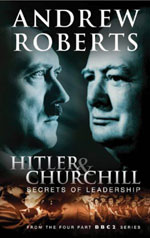
I began selling books three years ago and was immediately and lastingly struck by the popularity of Third Reich subject matter. Of course, such titles are rarely greeted with blockbuster sales. Most people are far more interested in recent Booker winners. But fascist-orientated history books, no matter how obscure their subject or confused their pretext, always sell well enough to justify their presence on the shelves. The Hitler industry may fall short of being a phenomenon, but it ticks along very nicely just the same. The target audience, so far as is discernable, would appear to be white English male professionals between the ages of 35 and 60. The decision-makers, then. Whatever their reasons for stuffing their homes with Nazi history (and I appreciate that there are fans of militaria just as there are fans of stamps and trainsets), it is their money which has created a situation where arguably no other political figure is flattered with so many column inches as Adolf Hitler. True, his symbiotic relative Winston Churchill has picked up recently, but even being voted the Greatest Briton Ever can't help Churchill top the literary popularity of his German rival. Not in Britain, anyway. It is a situation where a book like Kenneth Mackseys' Guderian - Panzer General, a biography of the ïgenius' tank commander and a relatively slim hardback priced at £25, has sufficiently good sales prospects (in a high street shop) to justify an initial order of ten glaring copies. A situation where it makes good sense for the tie-in to Andrew Roberts' Reich-bonanza TV series Secrets of Leadership, which ostensibly concerns itself with the success of a variety of leaders, to feature a picture of Hitler implacably staring out from the jacket. And one were Sutton publishing's German Army and German Navy hardbacks both trouble the top five History chart in my store, sales which would currently be most welcome were it not for the swastikas unapologetically emblazoned on their front covers. |
|
Clearly readers are attracted
by the Third Reich. No doubt there are plenty of worthy reasons why, but one
of the principal hooks would still appear to be glamour. Sometimes this is
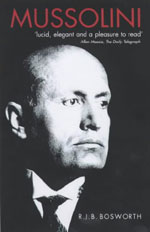
made explicit, as it was recently by R.L. Bosworth, ironically in the introduction
to his biography of Mussolini. Explaining the less crowded marketplace for
works on Italian fascism, Bosworth notes that many history students are more
intrigued
by 'the glamour of Nazi Germany'. Two other relevant points struck me about
Bosworth's book. The first was the supportive author quote on the front cover,
supplied by Alan Massie, who apparently found Mussolini 'a pleasure
to read'. Eh? The second came again from the introduction, where Bosworth spends
some time earnestly pointing out that he 'remains an anti-fascist biographer',
a strange disclaimer which would ideally be unnecessary were it not for the
rash of revisionist Italian hagiography currently available on the subject.
It should be pointed out that Mussolini is a highly academic and literary work, and there are of course many issues of quality, stance and author pedigree here. There have always been Hitler histories with a strong political, sociological and psychological interest. But problems remain with the uncritical and fancily packaged plethora of Third Reich spin-off titles; their cynical marketing, ambiguous sense of awe and sheer repetitive weight of numbers. When the blurb on these books uses embarrassed adjectives like ïhorrifying' to describe their contents, one can't help thinking that whatever is enclosed is not sufficiently horrifying that it stops people buying them, again and again. There is also the cautionary need to keep Nazism fresh in the memory. But is that what is happening here? Is that why people read these books? A kind of confused admiration would seem just as likely a motive (ïWas Hitler the greatest strategic genius of all time?' runs the fairly typical byline on John Strawson's Hitler As Military Commander). And while Martin Gilbert's last Holocaust-related title The Righteous sold poorly, I was astonished to discover that my shop had an equivalent market for Spellmount Publishing's Hitler Youth In Peace and War 1933-1945, a mostly pictorial effort that doesn't even pretend to be much other than a eulogy. |
|
Most of the current
outrage in popular history writing seems to be directed at Stalinism. Fair
enough. No sane person would dispute the horror of the man and his regime
and there has perhaps been insufficient vilification of both. Except... what
re-interpretation does Nazism undergo as a result? Muddying peoples perceptions
of Hitler through favourable comparisons with other tyrants is a stated tactic
of the current far right. Such a point may seem paranoiac at first glance.
But here is art historian Karl Ruhrberg, writing in a Taschen book on 20th
Century Art: 'a dangerously simplifying, ostensibly ïobjectifying' historiography
is in the process of reducing the unparalleled brutality of the National
Socialists to a ïnormal' level
by pointing out atrocities committed by others elsewhere.'
|