 | ||
 |
Tricky one, but Angels with Dirty Faces: What does that make you think of? A hit for Sham 69 in the summer of '78? Jimmy Pursey and his amazing dancing eyebrows, leering into the TOTP camera: "we're the kids you don't wanna know, we come from the places you don't wanna go." The punk snob in me utterly appalled, being already spoilt by Peel's esoteric selections four nights a week, yet the pop populist in me lapping it up and bellowing along like I used to with Mud and The Glitter Band.
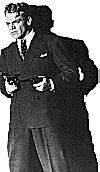
Or maybe James Cagney in the classic film? One of the few guaranteed to make me cry, when Cagney the irrepressible hoodlum is sentenced to the electric chair and childhood chum neighbourhood priest Pat O'Brian talks him into showing a yellow streak on the way to the chair rather than die a hero and have the local Dead End Kids looking up to him forever and a day. And I remember a review of the Fire Engines casting them as Dead End Kids left with a few Voidoids and Beefheart records to construct a (the?) future out of, though perhaps that ought to have been the Contortions and Subway Sect. So help me here: I remember another Cagney gangster classic, at least I think I do, when at the end an old 78 of 'I'm Forever Blowing Bubbles' is felt playing (well, a West Ham fan would remember that!) and Cagney climbs to the top of a gas tower or something and begs the authorities to come and get him, determined to go out in a blaze of glory. What was it? White Light? White Heat? I know that there was a Velvets connection in there somewhere. And wasn't it Bowie who sang "Ain't there one damn song that can make me break down and cry?", or something? I'll name you one or two: 'Make Me Sad' by Vic Godard or 'Maybe Kathleen' by Townes Van Zandt. I'll name you one book as well: The Outsiders by S. E. Hinton. S. E. Hinton's three great novels have been nicely collated and published in one volume by Collins, which is useful, as the Lions Tracks 'younger readers' editions they were available in were not exactly aesthetically acceptable. I've just read through the three stories again and have been struck by the understated strength of the tales and the emotional effect. Yes, I'll say it loud and I'll say it proud: the Outsider makes me cry and clench my fist and bite my lip and make vows and punch holes in walls and knuckle down and act up and learn and live and forgive and fight. These books are essentially teen-morality melodramas, like a Clash, Shangri-Las or Standells song. Classic themes recur: teenage kicks, gangs, leathers, switchblades, kids from the wrong side of town, hanging out, getting by despite broken homes, touched by tragedy, punks standing up for one another, standing up to one another, growing up, growing wise. That kind of thing. S. E. Hinton was 17 when The Outsiders was first published, yet I was older than 17 when I first read any of her books, having spent my teenage years reading Kerouac, Camus, Sartre and Salinger, and although I've had problems enough to contend with her characters I can't claim to be one of the young hoods portrayed so colourfully. Gangs were certainly a way of life, though I guess that brings us back to Jimmy Sham and the skinhead following he attracted who made life so lively basically. I was a good mod. I might have been into Orange Juice and Felt, but to all and intents and purposes I looked like a mod with my french crop and my hand-me-down original Levi Sta-Prests, and the skinheads did not like that. and some of the skinheads were not very nice at all, and indeed would later find fame as part of the Screwdriver Security / Blood and Thunder / BNP / Chelsea Head-hunters neo-Nazi fringe. Gangs did not make life a bundle of laughs in those days, but there's gangs and gangs. I remember seeing the Manic Street Preachers for the first time and THE fringe. Gangs did not make life a bundle of laughs in those days, but there's gangs and gangs. I remember seeing the Manic Street Preachers for the first time and THEY looked like a little gang. Standing in an empty pub function room in the West End of London, strange little mod-like characters, eager to be starting something, and wanting to say so much, yet what do we talk about? Golf! It was Richey who would quote at length from The Outsiders and the first Manics' song I ever heard was 'Colt 45 Rusty James' which directly referred to the final book in S. E. Hinton's teenage trilogy, Rumblefish. As a film it's something of a student staple, yet the short sharp book has so much more impact. The Motorcycle Boy is supposed to be 17 and as cool as they come, so Mickey Rourke? Please! The character of The Motorcycle Boy is one of the great literary creations and so much is left to the imagination that it's very hard to pin down exactly what's so fascinating. He's the outsider, the loner, the Face. He's the hardest but won't fight unless he has to. He's abstemious and has a weakness for bikes and books, and goes missing. I've always tried to cast him as a Vic Godard type of character no-one can figure, but you have to remember he is only 17, but then the Vic Godard story is equally strange. The other book in the trilogy? That Was Then, This Is Now, which is pure Dexys-style 'Show Me' / 'I'll Show You' story, full of morals and hard decisions, and I think S. E. Hinton's impossibly wise. I would have loved to be in her gang. It's not giving away any secrets, but to end it here I'll use one of her phrases: "I wish I was a kid again, when I had all the answers."
|
 |